I’ve been around payments for more than two decades, since Cybersource days.
Long enough to remember when internet payments themselves felt new, payment gateways were interesting pieces of technology, and putting your card details into a website required rather more faith than it does today.
My first exposure to the industry was in that world of online payments and fraud screening. Since then I’ve worked around banking, cross-border payments, fintech and the security and governance surrounding them.
A great deal has changed and a great deal hasn't.
We have APIs, mobile wallets, open banking, faster and real-time payments, increasingly sophisticated fraud analytics and now AI entering both sides of the equation.
Yet some of the conversations are surprisingly familiar.
At their heart, payments still depend on a handful of fairly basic questions:
Who are you? Are you authorised to do this? Can I trust the instruction? Has anything been changed? And where is the money actually going?
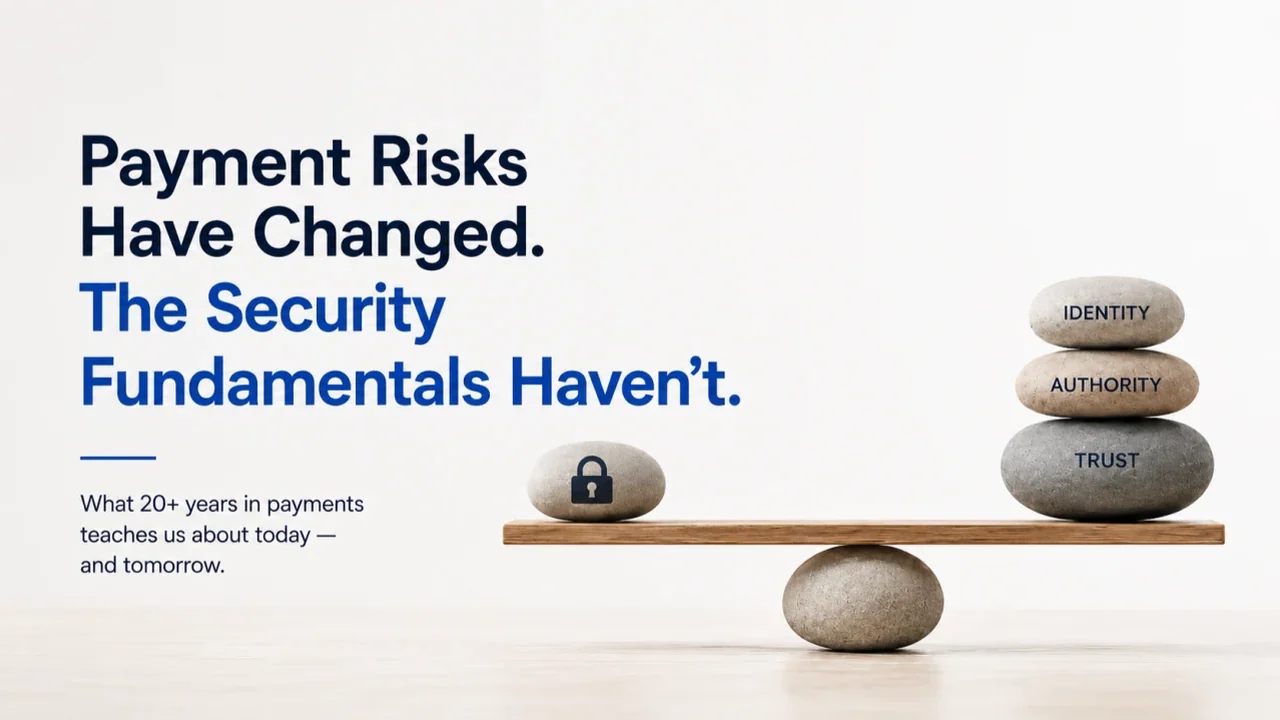
The technology has evolved significantly. The fundamentals of trust have not.
A valid payment instruction can still be fraudulent
The Bangladesh Bank heist in 2016 remains a useful example.
Attackers compromised Bangladesh Bank’s local environment and used its SWIFT-connected systems to generate fraudulent payment instructions. They attempted to move around $951 million from the bank’s account at the Federal Reserve Bank of New York. Most of the instructions were stopped, but $81 million reached accounts in the Philippines.
SWIFT itself made an important distinction afterwards: its network, software and core messaging services had not been compromised. The attackers had compromised the customer environment from which valid-looking SWIFT instructions were generated.
Think about that for a moment.
Further along the payment chain, what you see is a legitimate financial institution using a legitimate financial network to send apparently legitimate payment instructions.
The problem is that the party controlling those instructions is not legitimate.
The payment infrastructure can therefore do exactly what it was designed to do and still produce a very bad outcome.
Later, working around banking and cross-border payments, I encountered variations of the same underlying problem.
Authenticity of the channel is not necessarily authenticity of intent.
That distinction matters even more today.
Fraud adapts
Back in 2019 I wrote an article on LinkedIn about Authorised Push Payment fraud.
One of the examples was property conveyancing.
A criminal compromises or convincingly impersonates somebody involved in a house purchase, waits until a large payment is expected, substitutes different bank details and persuades the buyer to transfer the money.
Late on a Friday was particularly useful. By the time anybody became suspicious, the solicitor or estate agent might be unavailable and the weekend provided useful breathing space to move the money elsewhere.
That was not a hypothetical attack. It was happening then, and it still illustrates something important about payments fraud.
Many of the security controls can work perfectly.
The customer logs in correctly.
They authenticate themselves.
They use their own device.
They enter the payment.
They approve it.
The bank has correctly established who is making the payment. It is the customer.
Unfortunately, the customer has been deceived about why they are making it and who is really receiving it.
Confirmation of Payee closed one weakness, while reimbursement rules and regulation have also moved on considerably.
Fraud, unsurprisingly, did not decide that this was unfair and go home.
UK Finance reports that criminals stole £1.28 billion through payment fraud in the UK during 2025, four per cent more than in 2024. APP fraud accounted for £576.4 million, up 19 per cent. Of APP cases, 66 per cent originated online and another 17 per cent through telecommunications.
That last point is worth considering.
A substantial part of the payment-fraud problem begins outside the payment infrastructure.
A social media advert.
A marketplace.
A WhatsApp message.
A phone call.
A compromised email account.
The payment is simply where the deception crystallises into a financial loss.
Which is why I think the traditional organisational boundaries between cyber security, fraud and financial crime are becoming increasingly artificial.
Customers certainly don’t care which department’s risk taxonomy their missing £20,000 belongs to.
Their money has gone.
KYC is the start of the relationship, not the end
Payments also depend heavily on identity.
We quite rightly spend considerable effort establishing that somebody is who they claim to be when they become a customer.
But KYC answers a particular question at a particular point in time. Trust has to survive afterwards.
Money mule accounts demonstrate the problem rather neatly.
FCA data showed that 25 firms offboarded 194,084 money mules between January 2022 and September 2023. The regulator also found weaknesses in ongoing detection: after onboarding, only one of the firms reviewed was conducting real-time checks of existing customers against the National Fraud Database.
An account being genuinely opened by a real person does not mean it will subsequently be used legitimately.
Someone may knowingly provide access to it.
They may be recruited through a fake job.
They may move money without fully understanding what they have become involved in.
Or a previously legitimate account may simply start behaving very differently.
This doesn’t mean KYC is pointless.
Quite the opposite.
It means KYC alone cannot provide continuous assurance.
The useful question increasingly becomes less:
“Did we correctly identify this customer?”
and more:
“Do we still have sufficient confidence that the person, device or system carrying out this action is legitimately acting for that customer?”
That requires multiple signals: identity, device, behaviour, transaction context, destination, velocity and changes from what we have previously seen.
No single one necessarily provides the answer.
Collectively, they may tell us that something doesn’t smell quite right.
AI makes an old problem much more convincing
AI inevitably enters this discussion.
Machine learning in fraud detection isn’t particularly new. Payment organisations have been analysing transactions for anomalous patterns for years.
Generative AI changes something else.
It changes the economics of deception.
Research can be automated.
Phishing can be personalised.
Language becomes much less of a barrier.
Voices can be cloned.
Video can be fabricated.
And all of it can potentially be done at scale.
A rather sobering example occurred in Hong Kong in 2024.
An employee received a phishing email from somebody impersonating the CFO of the company’s UK head office and was invited to what appeared to be a group video conference concerning confidential transactions.
It wasn’t what it appeared to be.
Hong Kong Police concluded that the conference had been pre-recorded using deepfake video and audio derived from publicly available material. The employee subsequently authorised transfers to five local bank accounts.
The loss was around HK$200 million.
Consider how many familiar security-awareness messages that attack sidesteps.
Check the email.
Speak to your boss.
Don’t rely on an unusual written instruction.
Verify it using another communications channel.
Have a video call.
They effectively had the video call.
The attack itself was not particularly novel. Criminals impersonating executives to authorise fraudulent payments has been around for years.
AI made the impersonation considerably more convincing.
Old attack. Better tools.
And now the machine may genuinely be authorised
There is another AI development which I think may ultimately prove much more significant for payments.
AI agents are moving from providing information to taking actions.
That includes spending money.
This is no longer just a future-state slide in somebody’s strategy deck.
By December 2025, Visa said its partners had already completed hundreds of secure agent-initiated transactions. In June 2026, Visa and OpenAI announced a collaboration intended to bring Visa’s payment and security infrastructure into agentic commerce.
Mastercard is tackling the same trust problem through Agent Pay and uses the term “Know Your Agent”. Its model includes registering agents, identifying the user they represent, establishing delegation scope and using transaction intent and spending limits.
Apparently the payments industry hadn’t quite exhausted its supply of three-letter acronyms.
But KYA raises a genuinely important question.
For decades we have concentrated on knowing our customer.
Now we potentially have:
Customer → AI agent → merchant → payment provider → financial institution
The customer may be completely legitimate.
The agent may also be completely legitimate.
That still doesn’t necessarily mean the transaction is.
Who authorised the agent?
What exactly was it authorised to do?
Is there a spending limit?
Can it choose a different merchant?
Can it change payment method?
How long does its authority last?
What happens if the agent misunderstands an instruction?
What happens if somebody compromises it?
And who is accountable if an autonomous system makes a £5,000 purchase when its owner meant £500?
The security question changes from:
“Is this really Chun?”
to:
“Is this really Chun’s authorised agent, and is it doing something Chun actually authorised it to do?”
Different technology.
Very familiar trust problem.
And we are already looking beyond agents buying things for humans. Mastercard is openly developing payment infrastructure for environments where AI agents transact with other agents, continuously and at machine speed.
That takes the trust problem another step further.
Payments at machine speed
Speed is the final part of this.
Payments have progressively become faster, which is exactly what consumers and businesses wanted.
The side effect is fairly obvious.
Fraud gets faster too.
When money can move almost instantly into one account, onwards through others and potentially across multiple institutions, discovering the fraud several hours later may produce an excellent incident report.
It does not necessarily produce an excellent outcome.
The decision about trust increasingly has to happen before or during the transaction, not afterwards.
And as payments become more automated, those decisions increasingly have to happen at machine speed.
That brings identity, cyber security, fraud detection, financial crime, transaction monitoring and now AI governance increasingly close together.
Our organisational charts may not have caught up yet.
The criminals don’t particularly care.
Back to the fundamentals
Looking back over more than two decades in and around payments, I don’t think the lesson is that security hasn’t changed.
Clearly it has.
The scale is different.
The infrastructure is different.
The speed is different.
The criminals are better organised, and the technology available to both attackers and defenders would have seemed extraordinary when I first started working with internet payments.
What has changed is where we have to establish trust.
We started with systems and payment instructions.
Then increasingly with people and their digital identities.
Now we have to decide whether we can trust synthetic representations of people — and machines legitimately authorised to act for them.
Soon, machines will routinely transact with other machines, with humans potentially several steps removed from the individual payment.
Yet underneath all of that we are still trying to establish essentially the same things:
Identity. Authority. Integrity. Trust. Accountability.
Perhaps the biggest change is that increasingly we have to establish all five continuously and at machine speed.
The technology keeps changing. The fundamentals really don’t.
Personal commentary. Views are the author’s own.